
Displaying items by tag: kids camp
National KIND Kid Contest

Complete Details
| Students in grades K-6 are invited to apply for the Humane Society of the United States' KIND Kid Award. One winner will be selected to win $100 and two runners-up will each receive $50.
Applicants should submit a detailed description of how they have helped animals, including photos. Enter by January 15, 2011. |
Resource Types: Contest/Award
Audience Served: Families, General Public, Home Schools, Non-formal Educators, Private Schools, Public Schools, Scouts/Youth Groups, Teachers
Age Groups: Kindergarten, 1st Grade, 2nd Grade, 3rd Grade, 4th Grade, 5th Grade, 6th Grade, Adults
Environmental Focus: Animals/Wildlife, Biodiversity, Conservation, Ecology, Endangered Species, Environmental Health, Habitats/Ecosystems, Marine Education, Nature Awareness, Outdoor Skills/Recreation, Place-based Education, Sustainability
Academic Focus: Character Education, Interdisciplinary, Science
permalink=”http://www.swiftnaturecamp.com/blog”>
Summer school, all-year academic school, summer sports programs, and electronic media have become the elements of children’s summer activity in recent years. Children are kept occupied with indoor play activities. The playground has come indoors and narrowed in focus. The flickering light of computer monitors and handheld game screens has replaced sunlight and fresh air.
permalink=”http://www.swiftnaturecamp.com/blog”>
permalink=”http://www.swiftnaturecamp.com/blog”>
Modern times have come to call for change in the way we prepare our children to live life in the world they will inherit. Our kids simply must find a way to reconnect with our natural environment as they grow up. The global effort to restore ecological balance will need aware participants at every level. Environmental awareness always begins with a personal sense of connection to nature.
Parents can bring back awareness of nature to a child’s experience. Summer camp has been around since the 1920’s and is still an effective way to bring back balance to a child’s life. Trained staff members of modern summer camps can guide kids back into an alliance with nature through the pure fun of camp activities. The challenges of summer camp activities are fun rather than stressful, making them even more effective for learning how we are a part of nature.
Most directors of quality modern summer camps have developed policies that encourage camper experience that reconnects the camper to nature without sacrificing the great fun and memorable friendships that are the classic benefits of summer camp. One such policy is simple and sweeping: beginning by not permitting cellular phones, BlackBerries, pagers, radios, iPods, cassette or CD players, laser pens, TVs, Game Boys or digital cameras. Children forget that life is possible without these ubiquitous accessories. Not including them in the camp experience brings children a revelation: they find out that they can actually have fun and enjoy themselves living without those things.
A camp that combines traditional camp activities such as hiking, canoe trips and horseback riding with modern ways for campers to learn about nature will succeed in instilling environmental awareness in campers. Learning is potentially much more effective because it is associated with fun and friendships.
Summer camps have added modern awareness of health and nutrition to the established means of meeting physical needs such as good hygiene, exercise, and teamwork. Modern summer camps can offer a healthy menu that still includes foods that kids enjoy. A salad bar at lunch and dinner that includes a choice of fresh vegetables and salads is an example of this. Vegetarian meals should be made available to campers who have that preference. Fresh fruit can be made available all day for snacks. Nutrition is a part of a modern summer camp’s “green” approach to total wellness that includes providing means to develop of a camper’s positive self esteem, build friendships, and promote having FUN.
When they are discussing a possible choice of a camp with a camp’s directors, parents should ask about the sustainability of that camp’s own day-to-day ecological practices. How do they conserve energy and water and recycle? What is the camp doing to take responsibility for its own environmental footprint? Learning is a combination of information and participation. If a summer camp’s practices don’t reflect their talk, campers aren't going to absorb important messages about their own relationship with nature. Summer camps are becoming aware of the effects they are having on their immediate environment. Camp directors should be looking at the big picture and showing care for the earth as well as their campers.
It all started back in the days when American Bison ruled the Great Plains. At that time a rather nondescript grayish or black bird followed the herds around, feeding on seeds in the abundant supply of buffalo excrement. Settlers on the plains came to calling these animals buffalo birds.
permalink=”http://www.swiftnaturecamp.com/blog”>
permalink=”http://www.swiftnaturecamp.com/blog”>
But since the birds depended on wandering herds for food, they needed to wander as well if they wanted to survive.
The problem, of course, is that wandering birds can’t tend their nests. So the buffalo birds decided to leave their young in the care of other birds, an arrangement that seemed to work, at least from the buffalo birds’ perspective.
Then, during the 1800s, the prairies and buffalo disappeared, replaced by pasture and cattle. But the birds remained and started keeping company with cows instead of buffalo, eating insects in the grass, ticks on the livestock, and seeds and grain. The buffalo bird eventually became known as the cowbird.
Today there are two native cowbird species in North America, the Bronzed Cowbird of the Southwest and the Brown-headed Cowbird common in most of the United States and Canada. Both species still lay their eggs in the nests of other birds, which is to say that both maintain the parasitic tradition of their ancestors, much to the dismay of bird lovers and conservationists.
The main reason people find the cowbirds’ behavior objectionable is that it threatens biodiversity.
Cowbirds as a whole lay their eggs in the nests of more than 200 other species of birds. And in most cases, because these birds tend to be smaller species, the young cowbirds come to dominate the nests, pushing out the other young or hoarding the food. The result is that the two cowbird species thrive at the expense of hundreds of others.
The problem, of course, is that wandering birds can’t tend their nests. So the buffalo birds decided to leave their young in the care of other birds, an arrangement that seemed to work, at least from the buffalo birds’ perspective.
Then, during the 1800s, the prairies and buffalo disappeared, replaced by pasture and cattle. But the birds remained and started keeping company with cows instead of buffalo, eating insects in the grass, ticks on the livestock, and seeds and grain. The buffalo bird eventually became known as the cowbird.
Today there are two native cowbird species in North America, the Bronzed Cowbird of the Southwest and the Brown-headed Cowbird common in most of the United States and Canada. Both species still lay their eggs in the nests of other birds, which is to say that both maintain the parasitic tradition of their ancestors, much to the dismay of bird lovers and conservationists.
The main reason people find the cowbirds’ behavior objectionable is that it threatens biodiversity.
Cowbirds as a whole lay their eggs in the nests of more than 200 other species of birds. And in most cases, because these birds tend to be smaller species, the young cowbirds come to dominate the nests, pushing out the other young or hoarding the food. The result is that the two cowbird species thrive at the expense of hundreds of others.
Swift Nature Campers have spent time camping at the local National forests around camp, But, did you know you can make a part of those forrest a part of your Holiday Tradition. The 1.5 million acres of the Chequamegon-Nicolet National Forest (CNNF) offers many forest products the public can gather. If a person is interested in gathering any forest products they must first purchase a permit for a minimal fee.
permalink=”http://www.swiftnaturecamp.com/blog”>
permalink=”http://www.swiftnaturecamp.com/blog”>
This time of year some of the most popular permits are for Christmas trees, boughs and firewood permits. The costs and conditions of these permits vary depending on the forest product a person is seeking. To obtain more information, contact the Park Falls District Office at 715-762-2461, or visit the CNNF web-site at www.fs.usda.gov.
No Christmas tree cutting is allowed on Price County Forest land, but you can obtain a permit to cut boughs or firewood by calling the Price County Parks & Forestry Department at 715-339-6371.
To obtain a permit for cutting a Christmas tree, boughs, or firewood in the Flambeau River State Forest, call the forest office at 715-332-5271.
Summer school, all-year school, summer sports programs, and electronic media have become the staples of children’s play in recent years. Children are kept fully scheduled ....
with mostly indoor activities these days. The arena of play has come indoors. The light of the sun has been supplanted by the flickering lights of computer monitors and hand held game screens. Soon, however, changing times may call for a change in the way we consider our children prepared to live a whole life in the world they will inherit.
Our kids will need to find a way to reconnect with our natural environment to become participants in a global effort to restore ecological balance. Environmental awareness begins with a sense of personal connection to nature.
How do parents bring back balance to a child’s experience? One answer has been around since the 1920’s: summer camp. Modern summer camps can guide kids back into a natural alliance with nature through the pure fun of movement. The challenges of summer camp are fun rather than stressful, but they are no less effective for developing a child’s sense of confidence and independence.
One good example of a modern “green” summer camp is Swift Nature Camp near Minong, Wisconsin. The directors have developed policies that promote camper experience perfectly attuned to the needs of the times, without sacrificing the great fun and memorable friendships that are the classic benefits of summer camp.
Jeff and Lonnie Lorenz, directors of Swift Nature Camp, begin with their policy on electronic devices. “We do not permit cellular phones, BlackBerries, pagers, radios, iPods, cassette or CD players, laser pens, TVs, Game Boys or digital cameras. They simply are not what camp is about.”
Swift Nature Camp combines traditional camp activities with ways to immerse themselves in and learn about nature is likeliest to succeed in inspiring environmental awareness in campers.
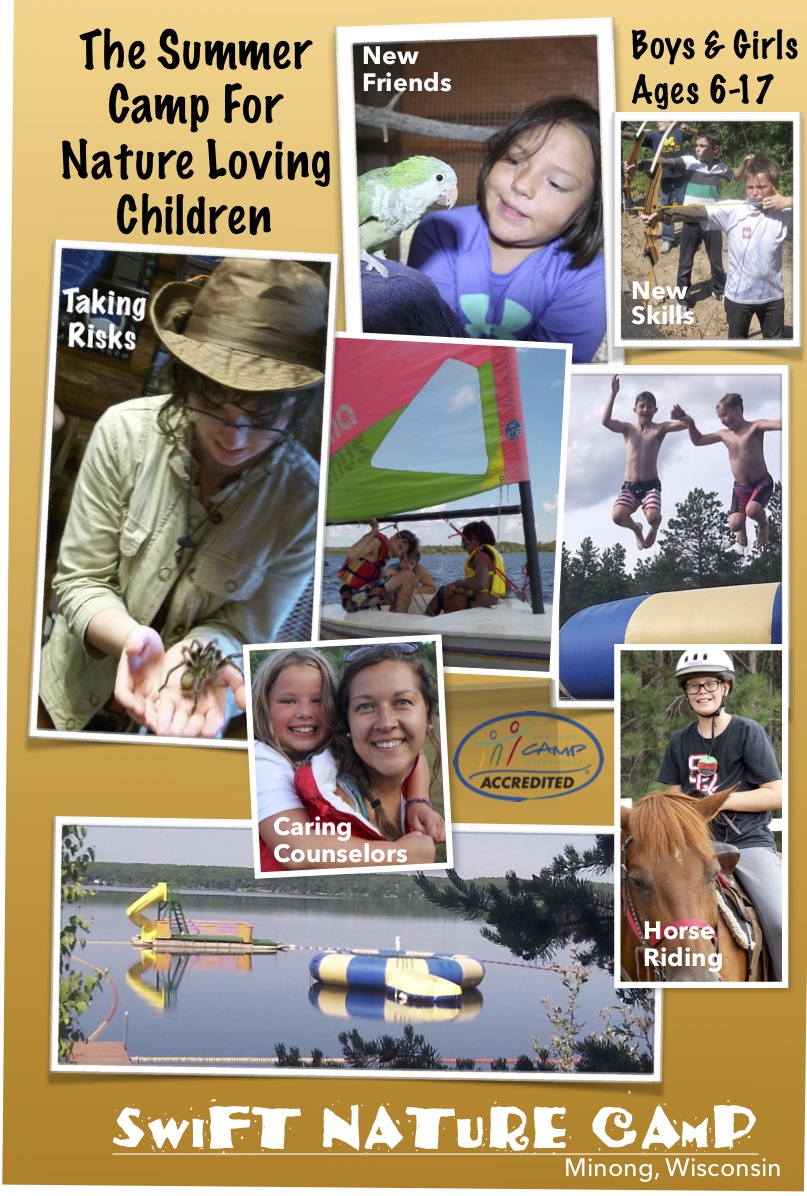
Summer seems a long way off, but now is the time to be looking atsummer camps to find just the right camp for your child. Remember that the best camps fill very fast. For that reason.......
Signing up far ahead of time is important. The first thing to do when selecting a kid summer camp is to look at your child’s needs and wants. Will they thrive in a sports camp or a general camp. What do they want from their summer? Skill building or building friendships?
Summer camps
should be a complete departure away from teachers and a time for mentors to step in. The essence of the best camps are imaginative, experienced and quick witted people who staff them. These mentors shape up the milieu of the camp so that every camper brings life lessons learned when he or she returns home. The experience which is gained and the knowledge acquired in every case go a long way in shaping up the overall persona of the person a camper becomes.
Kids Summer Camp
is a resource with more focus on arts and crafts with special regard to environmental consciousness. Kids go on from camp refreshed, delighted and full of experience when they return to regular classes in the fall. The exposure that summer camps offer a child will stay with the camper for the rest of a life as the wisdom that can only come from experience. How can parents with a good grasp of what is good for their kids find the right camp? The best place to search for obtaining precise information is of course the World Wide Web.
With a bit of patient research on the internet, you can easily lay your hands on some resourceful data. Parents might assume that if they are paying a higher rate for the kid summer camp that the child will return home with more education. They disregard the fact that the true meaning of summer camps is all about the experience. With the guided presentations of web program directors, the best traditional camps included have woken up to the archetypes involved in the whole process.
Parents ought to seek the best professionalism from persons representing summer camps. There is always a lot of apprehension and questioning for parents in terms of pros and cons their child will face in every social situation life brings. But the right kid summer camp is a good opportunity for every camper to socialize at a level which encompasses every facet of life.
So what can you do a camp that you cant do at Home? How bout shooting guns? Yep, one of the fun activity at this kids camp is riflery. This is one area at camp where there is no clowning around. We take teaching riflery very seriously. It may be a tradition at many summer camp. But we are very proud that our riflery range is our safest area at camp. At Swift Nature Camp we only shoot at targets and we shoot from the prone position (thats lying down) , our guns are single shot .22 caliber rifles. Our campers try to earn our camp Marksman awards. Often parents ask why have rifles at camp? The answer is ...we want to teach children how to properly and safely operate a gun. Campers also learn life lessons, like you need to practice and as you do practice bit by bit, you improve and before you know it you are loving Riflery.
permalink=”http://www.swiftnaturecamp.com/blog”>
permalink=”http://www.swiftnaturecamp.com/blog”>

Is seems as if we are learning more that Summer Camp helps children grow into mature adults. A new British study finds that most modern parents overprotect their kids. Half of all kids have stopped climbing trees, and 17 percent have been told that they can't play tag or chase. Even hide-and-seek has been deemed dangerous. And that dreaded stick...”will put out someone’s eye”.
It is easy to blame technology for the decline in outdoor play, but it may well be mom and dad. Adrian Voce of Play England says 'Children are not being allowed many of the freedoms that were taken for granted when we were children,' 'They are not enjoying the opportunities to play outside that most people would have thought of as normal when they were growing up.'
According to the Guardian, "Voce argued that it was becoming a 'social norm' for younger children to be allowed out only when accompanied by an adult. 'Logistically that is very difficult for parents to manage because of the time pressures on normal family life,' he said. 'If you don't want your children to play out alone and you have not got the time to take them out then they will spend more time on the computer.'
The Play England study quotes a number of play providers who highlight the benefits to children of taking risks. 'Risk-taking increases the resilience of children,' said one. 'It helps them make judgments,' said another. We as parents want to play it safe and we need to rethink safety vs adventure. The research also lists examples of risky play that should be encouraged including fire-building, den-making, watersports, paintballing, boxing and climbing trees. Summer camp provides an excellent opportunity for children to get outside take risks and play, all while still while being supervised by concerned young adults...we call counselors. See how Swift Nature Camp can put Adventure back into your childs life.
permalink=”http://www.swiftnaturecamp.com/blog”>
It is easy to blame technology for the decline in outdoor play, but it may well be mom and dad. Adrian Voce of Play England says 'Children are not being allowed many of the freedoms that were taken for granted when we were children,' 'They are not enjoying the opportunities to play outside that most people would have thought of as normal when they were growing up.'
According to the Guardian, "Voce argued that it was becoming a 'social norm' for younger children to be allowed out only when accompanied by an adult. 'Logistically that is very difficult for parents to manage because of the time pressures on normal family life,' he said. 'If you don't want your children to play out alone and you have not got the time to take them out then they will spend more time on the computer.'
The Play England study quotes a number of play providers who highlight the benefits to children of taking risks. 'Risk-taking increases the resilience of children,' said one. 'It helps them make judgments,' said another. We as parents want to play it safe and we need to rethink safety vs adventure. The research also lists examples of risky play that should be encouraged including fire-building, den-making, watersports, paintballing, boxing and climbing trees. Summer camp provides an excellent opportunity for children to get outside take risks and play, all while still while being supervised by concerned young adults...we call counselors. See how Swift Nature Camp can put Adventure back into your childs life.
permalink=”http://www.swiftnaturecamp.com/blog”>

Summer is on the way and children around the world are flocking to USA summer camps. THis uniquely American institution offers kids the opportunity to gain independence while learning school curriculums, music, sports, dance and acting camps. Yet one of the most popular is the traditional summer camp experience, where children play in nature and learn camping skills.
permalink=”http://www.swiftnaturecamp.com/blog”>
permalink=”http://www.swiftnaturecamp.com/blog”>
Regardless of the type of camp you and your child choose often parents feel separation anxiety from their children, especially in the case when this is a first time experience. Parents tend to become lonely when their are not around. However, parents just like children need to feel comfortable away from each other. Ones desire to be together is only proof of how well you are parenting. Here are a few ideas to reduce your anxiety while waiting for your camper to return.
• Be sure that you feel comfortable in the camp you have selected. Call the director a few times with in the first week to make sure your child is doing well. Now that you have no safety reason to worry it time to try and move on.
• Enroll in a special interest class. While your kid is away learning something new during the break, you too could see this as an opportunity to also address your personal interests. You could try enrolling in cooking classes or yoga courses. Whatever your preference might be, there is an available adult summer class for you.
• Date Night ! I once had a parent tell me”Now that the kids are not home me and the misses are going to be home all night in our undies” I don’t know if you need to do this but you can go out for a nice dinner and see a movie.
• Learn a hobby. You could learn how to do cross-stitching, baking, photography, or other things that interests you. This is the perfect time because your children won’t be around in a few days so nobody could disturb you. So take a class at the park or Jr. College.
• Finish or start reading your piles of books and finish watching your tons of DVDs . Nothing beats days of lazily doing nothing in the house and just being a couch potato. It would feel like you are back to being a teenager again because there are no kids to tend to.
• Pamper yourself for a day in the spa and a stroll in the mall to shop. Surely, you won’t really be depressed if you experience the things you love, right?
Remember camp is a growing experience for our children but at the same time its getting us ready for the day they move out to college.
• Be sure that you feel comfortable in the camp you have selected. Call the director a few times with in the first week to make sure your child is doing well. Now that you have no safety reason to worry it time to try and move on.
• Enroll in a special interest class. While your kid is away learning something new during the break, you too could see this as an opportunity to also address your personal interests. You could try enrolling in cooking classes or yoga courses. Whatever your preference might be, there is an available adult summer class for you.
• Date Night ! I once had a parent tell me”Now that the kids are not home me and the misses are going to be home all night in our undies” I don’t know if you need to do this but you can go out for a nice dinner and see a movie.
• Learn a hobby. You could learn how to do cross-stitching, baking, photography, or other things that interests you. This is the perfect time because your children won’t be around in a few days so nobody could disturb you. So take a class at the park or Jr. College.
• Finish or start reading your piles of books and finish watching your tons of DVDs . Nothing beats days of lazily doing nothing in the house and just being a couch potato. It would feel like you are back to being a teenager again because there are no kids to tend to.
• Pamper yourself for a day in the spa and a stroll in the mall to shop. Surely, you won’t really be depressed if you experience the things you love, right?
Remember camp is a growing experience for our children but at the same time its getting us ready for the day they move out to college.
Jeff Liken has spent 25 years working with teens and young adults, helping them navigate the perils of the adolescent stage of life to grow into confident, centered adults. He is also a summer camp consultant. Here are his thoughts for Bullying Awareness Month.
permalink=”http://www.swiftnaturecamp.com/blog”>
permalink=”http://www.swiftnaturecamp.com/blog”>
The most common trait we hear attributed to those who bully is that they lack empathy. They do not "feel the pain" of the victims as they inflict pain upon them, freeing them to act without guilt, shame or hesitation. Unbound by a social, emotional and/or moral consciousness, they can comfortably and easily do things that the rest of us would find unthinkable.
In my experience, few bullies are sociopaths. There is actually a spectrum of bullies in that regard, only a few whom fit that category, and many of them suffer from the "I am special so the rules don't apply to me" complex, not really from being a sociopath.
Most of those who do it though are not that extreme. The majority have developed a complex, sophisticated denial mechanism that allows them to hurt others, and be okay with it, reinforced by a story they tell themselves that justifies behaving this way. With little prodding, they feel deeply for what they are doing and easily reveal it - at least in the early stages of doing it.Being A Teen Today Is Insanely Stressful
Youth culture today is far more complex and high-pressured than it was when we were our kid's age. Most teens today have a sense of scarcity of resources and opportunities and their life feels like constant competition.
The school demands alone create more intellectual stress than most adults could easily manage as adults. The social pressures though, and the absurd standards that modern youth peer culture sets for one another, are far worse than most parents truly understand.
Many teens live with a sense that they are perpetually just one wrong choice or comment away from failure or rejection. Beyond worrying about school failure ("you won't get into a good college and thus your life is doomed" which is flawed thinking that is endlessly perpetuated by adults), their bigger fear comes in the form of worrying about being abandoned by the peer group, the modern equivalent of being kicked out of the tribe - especially because they spend the majority of their lives now in the tribe of their peers.
Consider this:• In 1950 youth between the ages of 12 to 18, spent 60 hours a week with adults and only 12 alone with peers.
• In 2010, this age group spends 60 hours a week in contact with peers, and less than 12 with adults.
• In "wired" homes in America, parents spend on average 4 minutes a day of uninterrupted time with their kids.
Today's kids are influenced mostly by machines (6 hours a day of screen time is the national average for today's teens), institutions (kids typically outnumber adults 24 to 1 in schools and spend 7 hours a day there 170 days a year) and countless hours a day being influenced by peers.
For many of them, being accepted by peer culture, having status in peer culture or proving themselves invincible to peer culture, becomes their highest concern and greatest source of stress.
The fear of being kicked out of the peer tribe that dominates their experience of the world, essentially equates at a deep psychological level, to certain-death. It’s no wonder it consumes so much of their time and energy. (Have you ever heard your teen daughter say, "If any one finds out about this, I'll die?" In their inner world, it is not just a cliché.)
In a survival situation all morality goes out the window. We'd do almost anything to survive. If not, you'd die.
Many of these bullies have a story they are living that links back to this.•If they were abused themselves, • they bully others to maintain their own status and value• it is to establish their dominance •it is to demonstrate to the "in-crowd" that they are funny and ruthless
I can go on and on, but most causes of bullying behavior comes back to the same thing:They are doing it and are okay with doing it because it is what they feel they need to do to survive, in a stressful, competitive world.
Until this changes, there is little adults can do besides continue to run around and clean up the messes. All the training in the world on recognizing the signs of bullying won't stop bullies from bullying.
Today's kids need to have the power taken back from popular culture, especially popular peer culture. The power these have over them trumps the power most parents have to influence their kids once they hit the middle school years.
This is not "just the way it is", nor is it indicative of a "normal stage of development". This is a modern creation, or perhaps better said, the pervasive by-product of the modern way of life that places so much emphasis on the things that matter least - and that demands parents be so consumed with things outside of home that they have little time or energy left to address what should be their primary concern: things going on inside their kids' lives.
It takes more than 4 minutes a day to raise kids to be morally and socially conscious people. It takes more than 12 hours a week of contact and attention from adults to influence kids to choose the values of mature adult culture over the values of popular adolescent culture. It takes more than just parents teaching kids about right and wrong, for kids to adopt these same beliefs.
I've built my life's work on becoming one of these critically needed adults in the lives of youth during their adolescent years. I hear their stories, know their struggles and "get" how complex and pressure filled their lives are. .. and how much time, repetition and time and repetition it takes to help them internalize a secure self-directed value set that frees them from peer approval dependence.
They need many more people doing what I do, teaching them real life skills, helping them construct their beliefs and values independent of the negative influences of society, giving them the reassurance that they matter, their lives count and they will succeed if they choose to live a life of uncompromising commitment towards the things that really matter. .. and giving them the real life experiences now that prove to them that they already have what it takes, far more so than they realize. We all needed it at their age, today more than ever.
Jeffrey Leiken, MA (leiken.com)





A Wisconsin DNR Property leased by Swift Nature Camp