Displaying items by tag: Summer Camp
Oh sure, I remember the days when I was a camper but over the last 40 plus years
I know my mind has altered the memories. Here in the enclosed info is the story line
of an overnight camper and how his story is much like that of a Hero form a book.
New Campers: A Hero’s Journey
I was first introduced to the story pattern of the Hero’s Journey when I took a screenwriting course in college and read The Writer’s Journeywhich uses the Hero’s Journey concept to help storytellers create their story. The Hero’s Journey describes the stages the main character (the hero or heroine) goes through in nearly every story in existence from plays to books to film.

The Hero’s Journey can also relate to our own personal lives and the lives of those around us. In fact, using the Hero’s Journey a person can find inspiration to create their own extraordinary life story.
But this is not a post about you or me. It’s not about creating or bringing meaning to our own story. Instead it’s about the journey that first time campers take, how they go through the stages of a hero’s journey. The next post I write will be about how we can enhance that journey and help our young heroes and heroins to grow and become better people through this experience we call summer camp.

The Stages
Stage 1 – Ordinary World
Every Hero starts off in the mundane world. They go to school, participate in activities, etc. But many times they have this feeling that something is missing, that there is more out there. Most kids have this sense of adventure and exploration that isn’t met at school or in the city. With dangers all around, parents don’t allow their children to stay out of the house and explore their surroundings like they used to years ago. That sense of adventure stays inside them, laying dormant.
Stage 2 – The Call to Adventure

In every Hero’s journey there is a moment when they get the Call to Adventure. For future campers they may hear about camp from an enthusiastic friend or from their parent who has sent away for a brochure. Some kids may have found information online. No matter how they found out about camp they have been Called to this new Adventure that awaits them and all the exciting opportunities it brings.
Stage 3 – Refusal of the Call

Now, our Hero, our future camper, has heard the Call to Adventure but is nervous about it. There are so many unknowns; will I make friends, will I have to shower with others, I’ll miss home, what if I don’t like it, will there be spiders in the cabin, will the other kids make fun of my snoring, will I like the food, are there bears, etc. This new adventure can be exciting but it can also be dangerous (and possibly life-threatning). It wouldn’t be a real adventure otherwise. Our Hero is refusing the Call to Adventure.
_____________________________________________
Creative License
Here is where I change the pattern of the Hero’s Journey a bit. In the classic version the Hero meets a Mentor that guides him or her to heed the Call to Adventure. So step 4 would be Meeting with the Mentor. Step 5 is Crossing the Threshhold where our Hero commits to the Adventure. In my structure those two steps are reversed as the Mentor in this typical scenario is the camp counselor that helps our Heros and Heroines through the tests of the Journey.
Now back to our story…
_____________________________________________
Stage 4 – Crossing the Threshold

Our Hero is now encouraged to answer the Call by parents, other family members, friends and even camp videos. Through this encouragement many children finally decide to commit to the Journey. They are going to camp. This commitment leads to all kinds of feelings and emotions. The camp fee has been paid and our Hero is gathering his/her gear for this Adventure (sleeping bag, toiletries, camera, clothes, etc.) and the feeling of excitement mixes with dread and anxiety. But our Hero must have courage (taking action in the face of fear). They must go forward. And our Hero does. They take the drive to camp and cross the Threshold onto the camp property where there are new sounds and sights. This is an unfamiliar place that is scary. Our Hero is committed though.
Stage 5 – Meeting with the Mentor

Now our Hero meets their Mentor, the camp counselor. The Mentor is confident, wise and protective. The Mentor knows that our Hero must face challenges during this Adventure but is there to help guide them through. The Mentor understands that our Hero will have to stretch him or herself, that they will grow as people through this experience.
While the Mentor may want to shield our Hero from adversity by letting them sit out of the challenges a camper faces (community living, camp competitions, high ropes course, swimming, performing, etc.) they also are wise enough to know that these challenges, these trials, are improtant to the Hero’s Journey.
Stage 6 – Tests, Allies and Enemies

Our Hero will face tests during this Journey. Our Hero may not know it but he/she is on a Journey for Treasure. That Treasure is completion of the Journey. It’s like a treasure chest filled with all the experiences, personal growth, relationships and memories that the Journey brings. But no treasure is worth having if there aren’t obstacles, challenges, tests, adversity.
The good news is that our Hero will not only have a Mentor but also Allies that will help our Hero get through it all. If our Hero goes to the pool for swim instruction their Ally will be the swim instructor. On the archery range it’s the archery instructor. Our Hero also has a cabin or group full of Allies (and possibly a few Enemies, which is also part of the Journey). These peer Allies will be important when it comes to camp competitions, ropes courses and team building, performing skits and evening activities such as camp dances.
Stage 7 – Approach to the Innermost Cave

On the first day of camp our Hero has met their Mentor and Allies, heard about the upcoming tests and challenges and have possibly met some Enemies (bullies, inner fear, bad food). At some point during the Journey our Hero will venture into the Innermost Cave, the darkest place they can imagine, the ultimate test. For many first time campers at resident (sleep-away) camp that Cave is night time where they will face their worst enemy - homesickness. As night approaches our Hero feels a knot growing in the pit of their stomach. They begin to think about home and mom and the safety of their rooms. Even their little brother, who they fight with constantly, is being missed right now. If our Hero has not created Allies or has created more Enemies than Allies at this point then homesickness will be strong.
For other campers the Innermost Cave can be the fear of heights on a ropes course, the fear of drowning in the pool, the fear of body image when in the community shower, the fear of not making friends, the fear of being made fun of or losing a camp challenge.
Stage 8 – The Ordeal

Our Hero must now deal with their fear. Hopefully the Mentor has recognized that our Hero is in the Cave facing his or her ultimate camp fear and is able to give our Hero advice on how to deal with it. Allies can also be a big part of getting through the Cave. For example, if our Hero has a fear of heights then his/her Allies will encourage our Hero to persevere as our Mentor gives clear, calm instructions. If our Hero does not face his/her demons then the Treasure may be lost to them. If homesickness leads to the parents taking our Hero home, if our Hero never leaves the gound at the high ropes course, if fear keeps our Hero from entering the water, then the memory of the Journey will be tainted, the sense of accomplishment will be lost, our Hero will not have stretched himself/herself and will have the hole in their soul to prove it. They MUST accomplish the task.
Stage 9 – Reward

Our Hero has conquered the fear, climbed the mountain, seized the sword, vanquished the dragon. They have emerged from their Ordeal. This was their initiation. They should now be recognized as special, a part of the select few that have conquered their fear. Now is the time for celebration. This may be an ending campfire, a group celebration of cheers and whoops, a token or trophy of their accomplishment or even a proud look from a mentor.
Stage 10 – The Road Back

Our Hero has done it – gone through all the experiences camp has to offer (and then some). The Treasure has been earned. Camp is over. Now it is time for our Hero to leave this Special World and return to the Ordinary World. But our Hero is not the same person they used to be. The Journey has strengthened them. Camp is no longer an unknown and scary place. It is a place of wonder filled with friends and Allies – a place where our Hero has learned that he or she can be courageous and do things they didn’t think possible. It is a place that taught them they could be without electronics, a place they found independence, a place they stretched and grew.
Stage 11 – Resurrection

But the story does not end there. Now that our Hero is home they must cope with a new Ordeal – the Oridanary World. The excitement fades as the Special World is out of site. Our Hero wants to return to the place of wonder, but they cannot. They have left a place of acceptance, encouragement, love, peace, challenge and accomplishment only to return to a harsh reality. This seperation anxiety is tough for many Heroes. Their new friends and Allies are missed, as is the Mentor who guided them through so much.
Camp is a place where kids can be someone else, someone better. They can start fresh. When they come home they return to the people that know them and their weaknesses. These people (family and hometown friends) weren’t there to see the strength our Hero used and the accomplishments our Hero made.
This is a time of rebirth, where our Hero sheds the personality of camp and builds a new one suitable for the Ordinary World, taking the lessons they learned on their Journey and fusing that with the best parts of their old selves – like a Phoenix rising from the ashes.
Stage 12 – Return with The Elixer

Now that our Hero has returned to the Ordinary Life and has ressurected into their new selves they bring back with them the Elixer – stories, pictures, momentos of their Journey, their Adventure, that they can share with others. This may inspire friends to go on journeys of their own. This may be the Call of Adventure for others that hear our Hero’s tales. The Elixer is the final part of our Hero’s Journey. It is the proof that our Hero was there, that he or she vanquished the dragon showing all others what is possible and that it is a Journey worth taking.
Once everyone back home has heard the tales our Hero has brought back – the time is right to plan the next journey.
this article is from http://summercampprogramdirector.com/new-campers-a-heros-journey/
Our kids will need to find a way to reconnect with our natural environment to become participants in a global effort to restore ecological balance. Environmental awareness begins with a sense of personal connection to nature.
How do parents bring back balance to a child’s experience? One answer has been around since the 1920’s: summer camp. Modern summer camps can guide kids back into a natural alliance with nature through the pure fun of movement. The challenges of summer camp are fun rather than stressful, but they are no less effective for developing a child’s sense of confidence and independence.
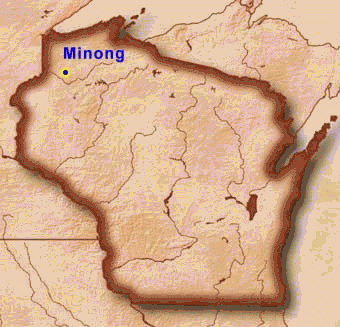
One good example of a modern “green” summer camp is Swift Nature Camp near Minong, Wisconsin. The directors have developed policies that promote camper experience perfectly attuned to the needs of the times, without sacrificing the great fun and memorable friendships that are the classic benefits of summer camp.
Jeff and Lonnie Lorenz, directors of Swift Nature Camp, begin with their policy on electronic devices. “We do not permit cellular phones, BlackBerries, pagers, radios, iPods, cassette or CD players, laser pens, TVs, Game Boys or digital cameras. They simply are not what camp is about.”
Swift Nature Camp combines traditional camp activities with ways to immerse themselves in and learn about nature is likeliest to succeed in inspiring environmental awareness in campers.

Live Long and take care of your Health.... Make good choices
permalink=”http://www.swiftnaturecamp.com/blog”>
| The Wisconsin No Child Left Inside Coalition is working to develop an Environmental Literacy Plan for Wisconsin that will address the environmental education needs of Wisconsin's pre-kindergarten through twelfth grade schools and will pay special attention to creating more opportunities to get kids outside. The Plan will recommend a comprehensive strategy to ensure every child graduates with the environmental skills and knowledge needed to contribute to a sustainable future.
Wisconsin has a strong environmental education foundation already established, with active schools, supporting organizations, and abundant opportunities to get outside in rural and urban settings. The Environmental Literacy Plan will build upon these strengths, and suggest priorities for present and future attention. It will lay out the next steps towards fulfilling on our State's commitment to ensure all people in Wisconsin are environmentally literate. Currently, the Wisconsin NCLI Coalition is made up of representatives from: the Wisconsin Department of Public Instruction, Wisconsin Center for Environmental Education, Wisconsin Environmental Education Board, Wisconsin Environmental Education Foundation, Wisconsin Association for Environmental Education, Wisconsin Department of Natural Resources, Wisconsin Environmental Science Teachers Network, Milwaukee Public Schools, the Green Charter School Network, and the Environmental Education and Training Partnership. State Superintendent Evers has formally asked the Coalition to develop the Environmental Literacy Plan for Wisconsin. Wisconsin’s Environmental Literacy Plan will be compliant with the pending national No Child Left Inside (NCLI) legislation. The No Child Left Inside Act requires States develop, implement, and evaluate a State Environmental Literacy Plan in order to be eligible to receive funding associated with the Act. Currently, the bill suggests an appropriation of $100 million to support the State Environmental Literacy Plans. You can learn more about the |
Recently Backpacker Magazine set out to find the best cities to raise kids in Nature. Suprisingly, or maybe not, Duluth was ranked in the top 25. These are the best places in America to “beat Nature Deficit Disorder.” Read more atOutdoors Camp. That’s not too surprising when you think about all the incredible fun outdoor things to do around Swift Nature camp. Remember Lake Superior, Apostle Islands, Amnion Falls, Superior Hiking Trail and THe Boundary Waters. So nest summer do What Back Packer Magazine Recommends go Play Outside in the Northwoods of Minnesota.
The Wisconsin No Child Left Inside Coalition is working to develop an Environmental Literacy Plan for Wisconsin that will address the environmental education needs of Wisconsin's
permalink=”http://www.swiftnaturecamp.com/blog”>
Many parents believe that children need to spend more time outside in nature. They are looking for summer programs to supplement these state goals. Environmental Summer Camps are just one way parent can do this.
Wisconsin has a strong environmental education foundation already established, with active schools, supporting organizations, and abundant opportunities to get outside in rural and urban settings. The Environmental Literacy Plan will build upon these strengths, and suggest priorities for present and future attention. It will lay out the next steps towards fulfilling on our State's commitment to ensure all people in Wisconsin are environmentally literate.
State Superintendent Evers has formally asked the Coalition to develop the Environmental Literacy Plan for Wisconsin. A Steering Committee meets each month to draft the Plan. The Wisconsin No Child Left Inside Coalition Steering Committee is made up of representatives from the Wisconsin Department of Public Instruction, Wisconsin Center for Environmental Education, Wisconsin Environmental Education Board, Wisconsin Environmental Education Foundation, Wisconsin Association for Environmental Education, Wisconsin Department of Natural Resources, Wisconsin Environmental Science Teachers Network, Milwaukee Public Schools, the Green Charter School Network, and the US EPA's Environmental Educationand Training Partnership. The broader Coalition is kept updated on progress, provides input and feedback to guide the plan development, and ultimately, willplay a key role in implementing and evaluating Wisconsin's Environmental Literacy Plan.
Wisconsin's Environmental Literacy Plan will be compliant with the pending national No Child Left Inside (NCLI) legislation. The No Child Left Inside Act requires States develop, implement, and evaluate a State Environmental Literacy Plan in order to be eligible to receive funding associated with the Act. Currently, the bill suggests an appropriation of $100 million to support the State Environmental Literacy Plans. You can learn more about the national NCLI Act and its various provisions and requirements here: www.cbf.org/Page.aspx?pid=948.
Much of the information was supplied by "EE IN WISCONSIN", A guide to Wisconsin's environmental education organizations, programs, materials, and professionals. For more information about Wisconsin's NCLI Coalition, contact Jesse Haney (This email address is being protected from spambots. You need JavaScript enabled to view it.).
If you are looking for Summer Camp for your children, please see SummerCampAdvice.com a FREE reference. Selecting the right summer camp is so important so be sure to do your homework, it will pay off in the end.
Hey!
Jacob here, I will be in the Nature Center this summer teaching you all about the big beautiful outdoors.. I like to fish, hunt and play sports. This is my first summer at camp but at school I’m studying youth programming and camp management. I love being outside and making new friends... ( this is my new friend here in the picture :) It is going to be a great summer!


Ninety percent of all forest-related fires in Wisconsin are started by humans. Education is a key prevention tool to develop an informed and caring citizenry that will take action to prevent useless fires and who support the use of prescribed burning as a management tool. This was the main point to the lessons recently taught at Swift Nature Camp.
Swift nature Camp invited the Minong and Solen Springs 5th grade classes out for 3 days and 2 nights of Science Camp. it was the last day when students had 2 fire presentations. The first was held by the local DNR, where they spoke how important it was to protect against wild fires and how they put them out. THe second presentation was by the local fire department and how they protect the local residents with their fire equipment. These 2 classes were very informative and kept the kids involved.
permalink=”http://www.swiftnaturecamp.com/blog”>
Unlike other environment-related programs impacting schools, the Green Ribbon award will acknowledge high levels of achievement under three areas, rather than one:
1) environmental impact and energy efficiency;
2) healthy environment; and 3) environmental literacy.
Congressman Sarbanes, sponsor of the No Child Left Inside Act, praised the new program. "Robust environmental education will prepare students to be 21st Century innovators – developing technologies that are crucial to the future health of the environment and the American economy," Sarbanes added. “I am thrilled that the Department of Education has brought this new focus to environmental education.” To read the Congressman’s full press release, click here.
Don Baugh, Executive Director of the No Child Left Inside Coalition also lauded the program as a step in the right direction. “Recognizing schools for their environmental education achievements is an important part of the effort to advance the environmental literacy of our youth,” said Baugh. “Equally important is ensuring that the Elementary and Secondary Education Act provides support for schools to provide the high quality environmental education needed to prepare our students for college and the jobs of the future. We commend Secretary Duncan and Congressman Sarbanes for their leadership on this critical issue.”
- Arts Camp (3)
- Best summer camps (34)
- Camp Counselors (16)
- Campers R Talkin' (6)
- Canoe Camp (7)
- Children's Summer Camp (96)
- Coed Summer Camp (2)
- Eco Friendly Summer Camp (8)
- Environmental Camp (37)
- Girls Summer Camp (5)
- Green summer camps (2)
- Hiking Camp (4)
- Horse Camp (1)
- Kid's Camp (36)
- Minnesota Camp (19)
- Movies (2)
- Nature Camp (57)
- Old Fashioned Summer Camps (12)
- Outdoor Youth Camp (33)
- Playing Outside (13)
- Riflery Camp (3)
- Science Camp (41)
- Science Summer Camp (20)
- Shooting Camp (1)
- SNC REVIEWS (1)
- Sports Camp (4)
- Summer Camp (72)
- Summer Camp Advice (47)
- Summer Camp Discounts (5)
- Summer Camp Savings (9)
- Summer jobs (21)
- Summer Youth Camp (25)
- Swimming Camp (3)
- Teen Camp (12)
- Traditional Summer Camps (11)
- Travel Camp (3)
- Wisconsin Camp (20)
- Parents (86)
- More Camp Information (1)
- Camp News (44)