


Displaying items by tag: Summer Camp
At Swift Nature Camp our campers tend to be those smart kids who like to learn and since they have no screens, they have plenty of time to read. At this old fashioned summer camp we have an achievement award for those campers that read while at summer camp. It takes a little prioritizing but their are plenty of opportunities to read, before bed, quiet time and even outside during activities. Our camp library is loaded with books that campers can choose from. However recently I found this article with a list of books that you might want to give your camper to read at camp
Summer Camps Activities 2020: Campers, Be Sure To Pack These Books This Summer
Sleeping bag: check! Flashlight: check! Books to read …
For children and teens not sure what books to bring to their overnight camp this summer, C.H. Booth Library’s librarians have them covered.
Children’s Librarian Alana Bennison and Young Adult Librarian Catherine Findorak have crafted a list of camp-specific books that will be sure to keep pages turning well after the campfires have died out and the counselors have called lights out.
Young Readers: First Through Third Grade
Camp would not be complete without some ghost stories, and The End of Orson Eerie? by Jack Chabert helps with just that. The spooky book is part of the Eerie Elementary Series, which consists of easy-to-read text and illustrations on every page.
Another popular children’s book series is the Bad Kitty series by Nick Bruel. It features Bad Kitty Camp Daze, which chronicles the hubbub that ensures when the main character, Kitty, bonks her head, causing her to act like a dog, and gets sent to Uncle Murray’s dog camp.
Grow Grateful by Safe Foster-Lasser and Jon Lasser is a lighthearted read for children that features character Kiko embarking on a campingq trip with her class where she learns about gratitude. The book even provides advice and tips for mindfulness and being grateful.
Campers looking for a heart-racing, white-knuckle inducing story can check out I Survived the Attack of the Grizzlies, 1967 by Lauren Tarshis. There, the readers will learn the dangerous tale of an 11-year-old girl coming face-to-face with a grizzly bear in the wild.
Another book shining light on the great outdoors is The Camping Trip That Changed America by Barb Rosenstock. The book highlights the true story of President Theodore Roosevelt and naturalist John Muir’s trip to Yosemite in 1903.
Middle Grade: Fourth Through Sixth Grade
Fans of Peter Nimble and His Fantastic Eyes will enjoy the follow up book Sophie Quire and the Last Storyguard by Jonathan Auxier. The fictional journey takes the characters on an adventure they will never forget.
Out of the Wild Night by Blue Balliett will keep readers on their toes as they read about ghosts who select a group of children to help save the island of Nantucket.
Released just last September, The Light in the Lake by Sarah Baughman is perfect for campers by the water. It tells the tale of a 12-year-old girl studying Maple Lake’s pollution; what she discovers will cause her to make a pivotal choice.
The great outdoors is the setting in The Wild Robot by Peter Brown, where a robot named Rozzum unit 7134 — also known as Roz — finds herself on an isolated island where she has to find a way to survive in nature.
Waste of Space by Stuart Gibbs is the third and final installment in the New York Times bestselling Moon Base Alpha series. As exciting as it is to travel the world, this book takes readers on an adventure in space to solve a murder and rescue the moon base commander.
Fans of Kelly Barnhill, Michael Buckley, Adam Gidwitz, Adele Griffin, Lisa Brown, Claire Legrand, Nikki Loftin, Daniel José Older, Dav Pilkey, R.L. Stine, and Rita Williams-Garcia will be delighted to read Guys Read: Terrifying Tales edited by Jon Scieszka. The book features a collection of ghosts stories from each author with illustrations by Gris Grimly.
Those looking for a fright in the night can also dive into The Haunting of Henry Davis by Kathryn Siebel about two kids who meet a ghost named Edgar. The duo goes on an adventure to find out who Edgar was when he was alive and why he has chosen to haunt Henry now.
Grades 5 And Up
A popular young adult series capturing the hearts and attention of graphic novel readers is Lumberjanes, Volume 1 to 13, by Noelle Stevenson. The series features five teenage best friends at Scout camp who go on adventures solving mysteries and fighting monsters.
Another graphic novel sure to delight older campers is the coming-of-age story All Summer Long written and illustrated by Hope Larson. When her best friend leaves for summer camp and our protagonist Bina is left to figure out how to spend her time, she discovers a new friendship based on a mutual love of music.
Grades 8 And Up
With the last book in the “Arc of a Scythe” trilogy by Neal Shusterman finally released last November, campers can binge-read all three books — Scythe, Thunderhead, and The Toll. The dark series takes readers to a fictional world where humanity has conquered everything from hunger and disease to war, and even death. Two teens must apprentice with a scythe, whose job it is to take people’s lives, and if they fail, their own lives could be at stake.
The graphic novel This One Summer by Mariko Tamaki tackles some adult content as its main character, Rose, goes through the turbulence of fighting parents and the unexpected discovery of an older teenager being involved in something life threatening.
So, children and teens heading off to overnight camp this summer will need to be sure to scoot over their toothbrush and socks to leave a designated spot in their knapsack for these page-turning reads.
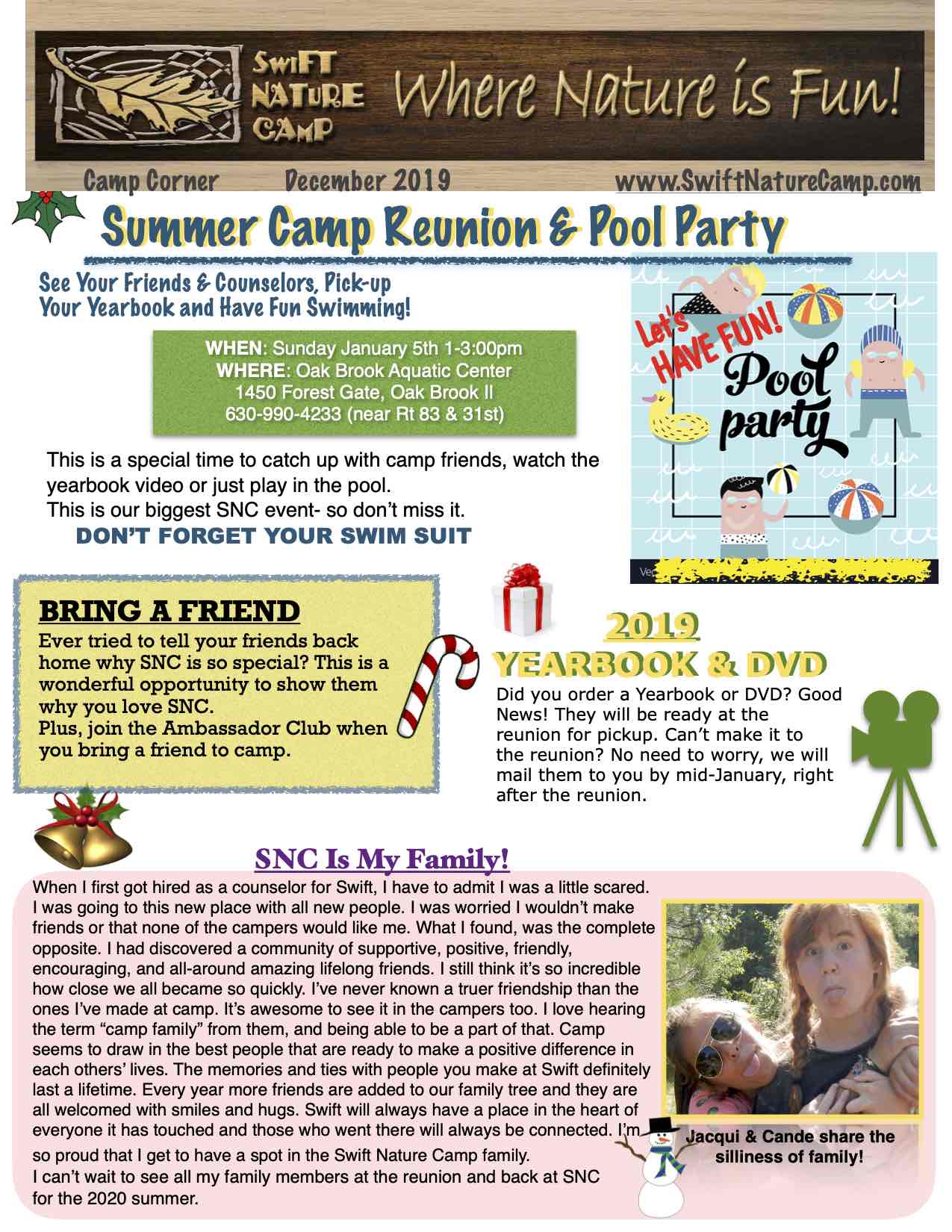

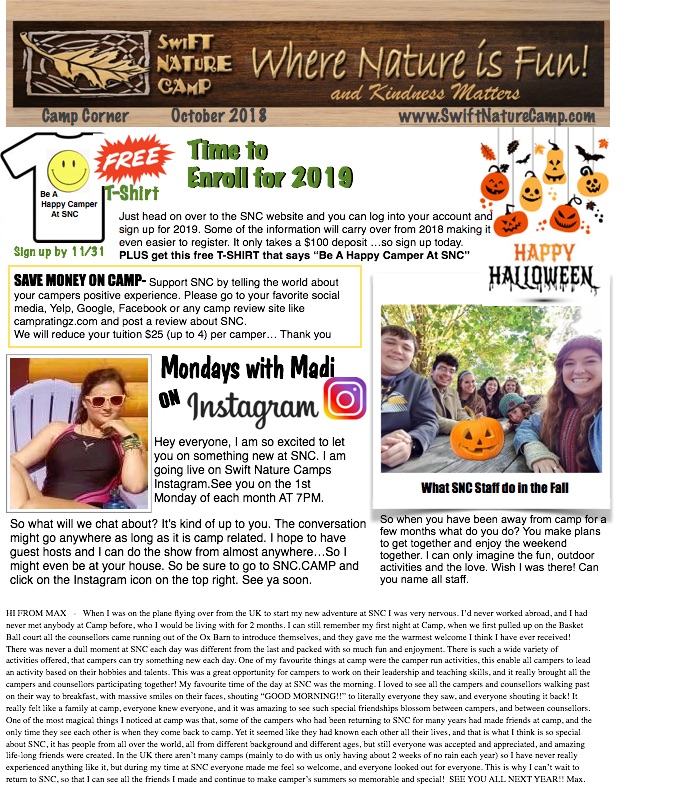
Come to the Swift Nature Camp
Informational Open House
in Chicagoland May 27th - MEMORIAL DAY.
Our Open House is a wonderful time to learn more about camp by meeting the Directors (Lonnie & Jeff), staff and other campers. If you are already enrolled in camp this is a wonderful time to meet new friends and play games with the other campers and counselors. You can even bring a friend. We will take a hike round Willowbrook Wildlife Center and explore the animals and activities. If you have not committed to SNC and are still thinking we might be the right camp for you, please come with your questions. We hope you can make it to this fun program. Please dress for the weather. If you have any questions call us at 630-654-8036.
We hope to see you there, Lonnie & Jeff
OPEN HOUSE AT THE WILLOWBROOK WILDLIFE CENTER
Why Come? Have your questions answered, Feel more comfortable with the owners and staff, Make firends, Help campers feel good cabout camp
Camper Games and Hike-START TIME: 1pm
Parent Information -START TIME: 1pm
Camper & Parent Question & Answers: 2pm
Ending 3pm
WHERE: Willowbrook Wildlife Center (across from the College of DuPage) Glen Ellyn Il
WHO: Campers Enrolled or Families that are considering SNC and want more information
DIRECTIONS to Willowbrook Wildlife, Center Glen Ellyn, Il
WILLOWBROOK WILDLIFE CENTER IS LOCATED on the east side of Park Boulevard across from College of DuPage, one mile south of Roosevelt (Rt. 38) and one mile north of Butterfield Road (Rt. 56). ph(630) 942-6200
525 S Park Blvd, Glen Ellyn, IL 60137
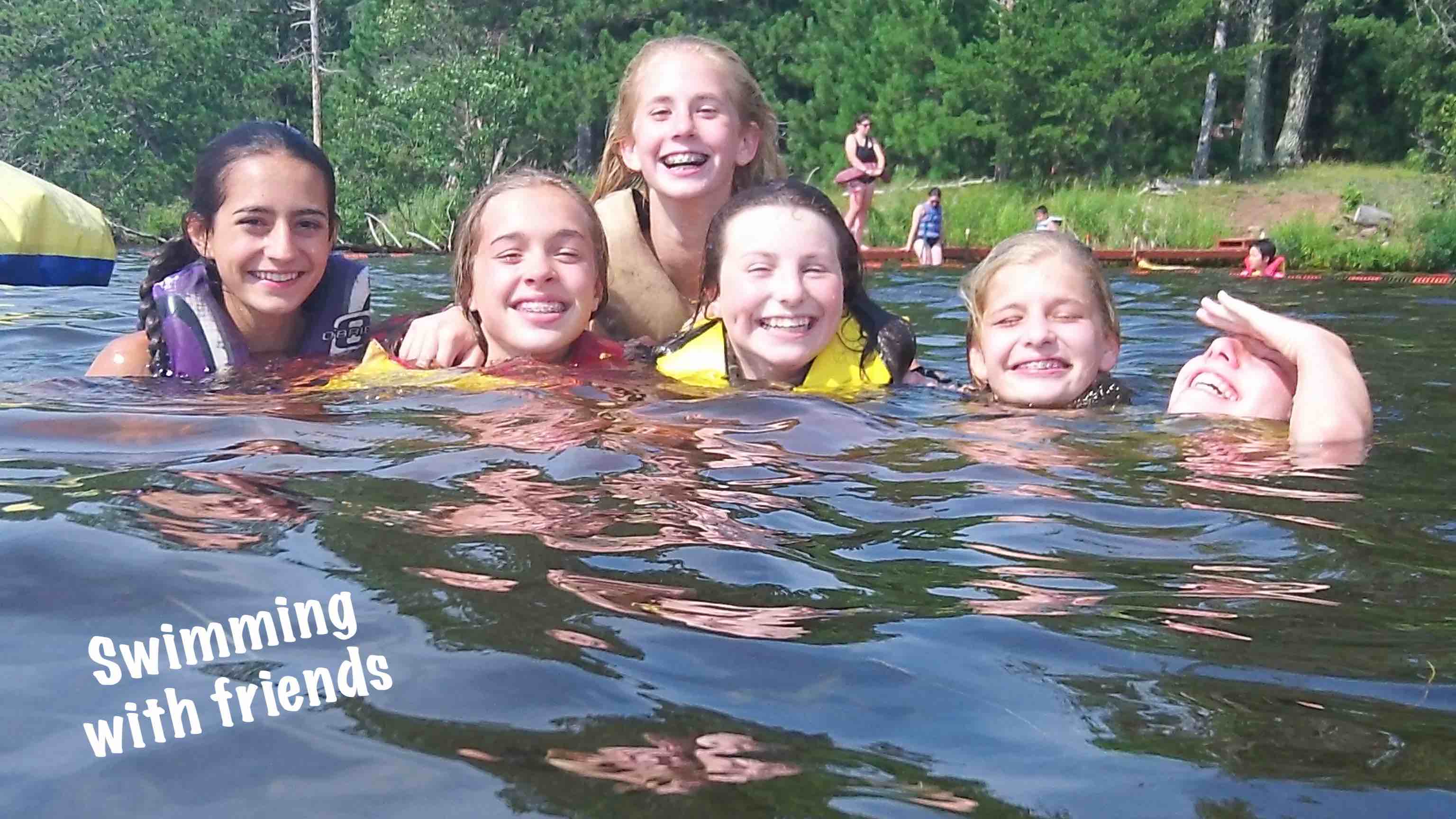
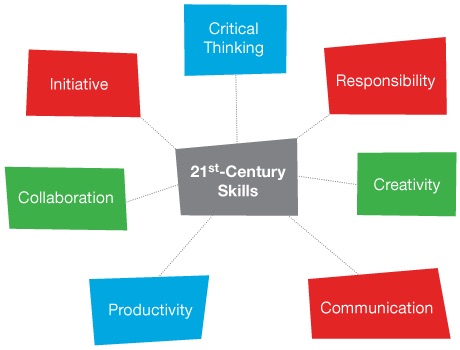
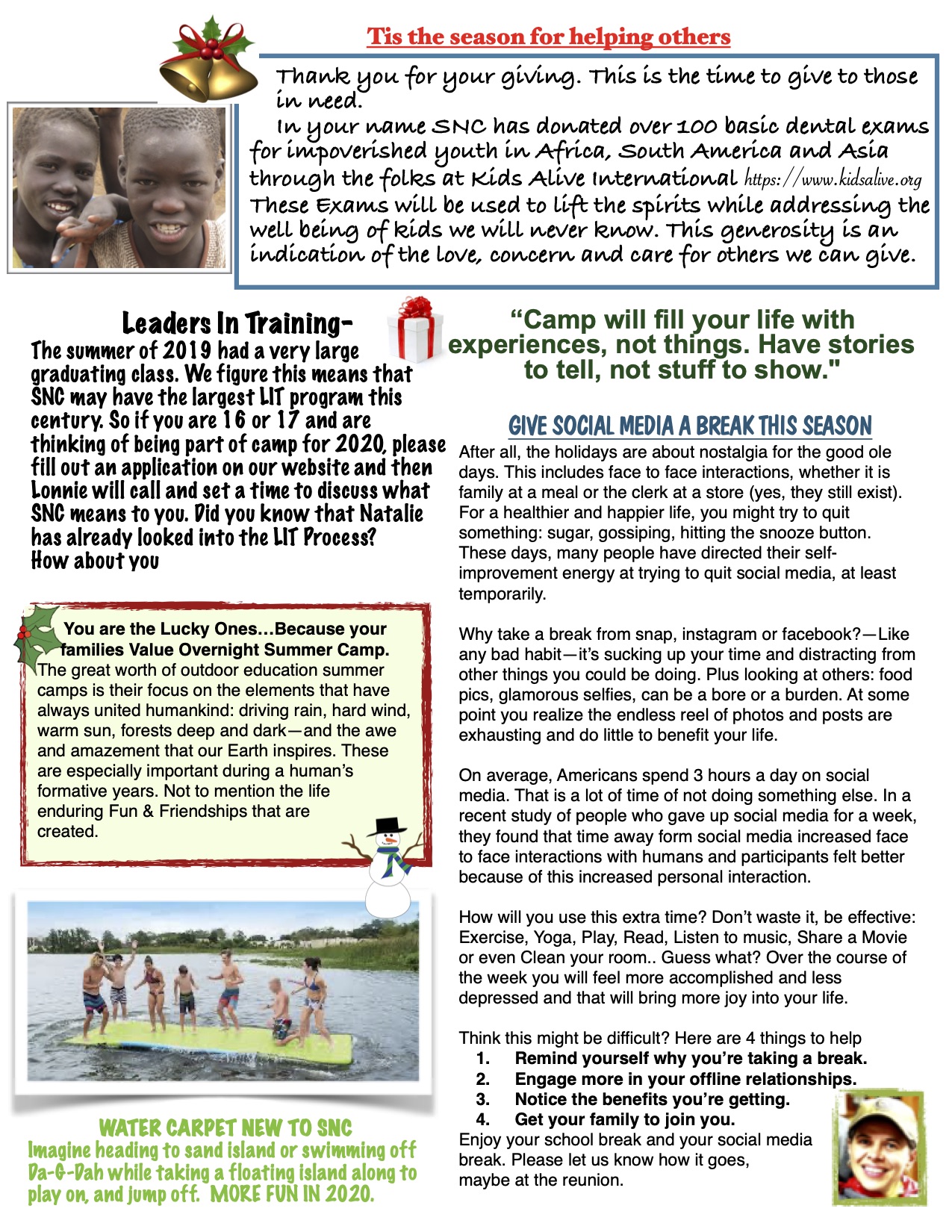
Overnight summer camp is more than Fun & Games. Sure, the plan is to have fun and make new friends. Research is showing that computers and robots will take away many jobs in the future. But what technology can not achieve, are the soft interpersonal skills. Living with others in a communal setting like camp provides campers to learn empathy, problem solving skills, leadership and independence.
The Top 10 Outcomes of Experiential Learning at Camp
“Camp is an experience every child deserves,” according to the American Camp Association (ACA), which accredits more than 2,400 camps serving more than 7.2 million children and teens. Specifically, ACA points to the "joy" kids experience when they make new friends and the inherent value in unplugging from their electronic devices, enjoying being out of doors, connecting with other young people, and learning about themselves.
And the ACA adds that, from a quantifiable perspective, the outcomes of a summer camp experience include the same skills that are needed in the 21st Century.
-
Friendship skills: Make friends and maintain relationships.
-
Independence: Rely less on adults and other people for solving problems and day-to-day activities.
-
Teamwork: Be more effective working in groups of peers.
-
Family citizenship: Gain attributes important to being a member of a family.
-
Perceived competence: Believe that they can be successful in the things they do.
-
Interest in exploration: Be more curious and eager to learn new things.
-
Responsibility: Learn to be accountable for their own actions and mistakes.
-
Affinity for nature: Develop feelings of emotional attraction toward nature.
-
Problem-solving confidence: Believe they have abilities to resolve problems.
-
Spiritual well-being: Develop purpose and meaning in life.
Gaining experience in these highly valued non-cognitive or soft skills will be life changers for today's youth. Cap provides a safe place to hone leadership and social entrepreneurship skills.
10 Reasons to Send Your Child to Overnight Summer Camp
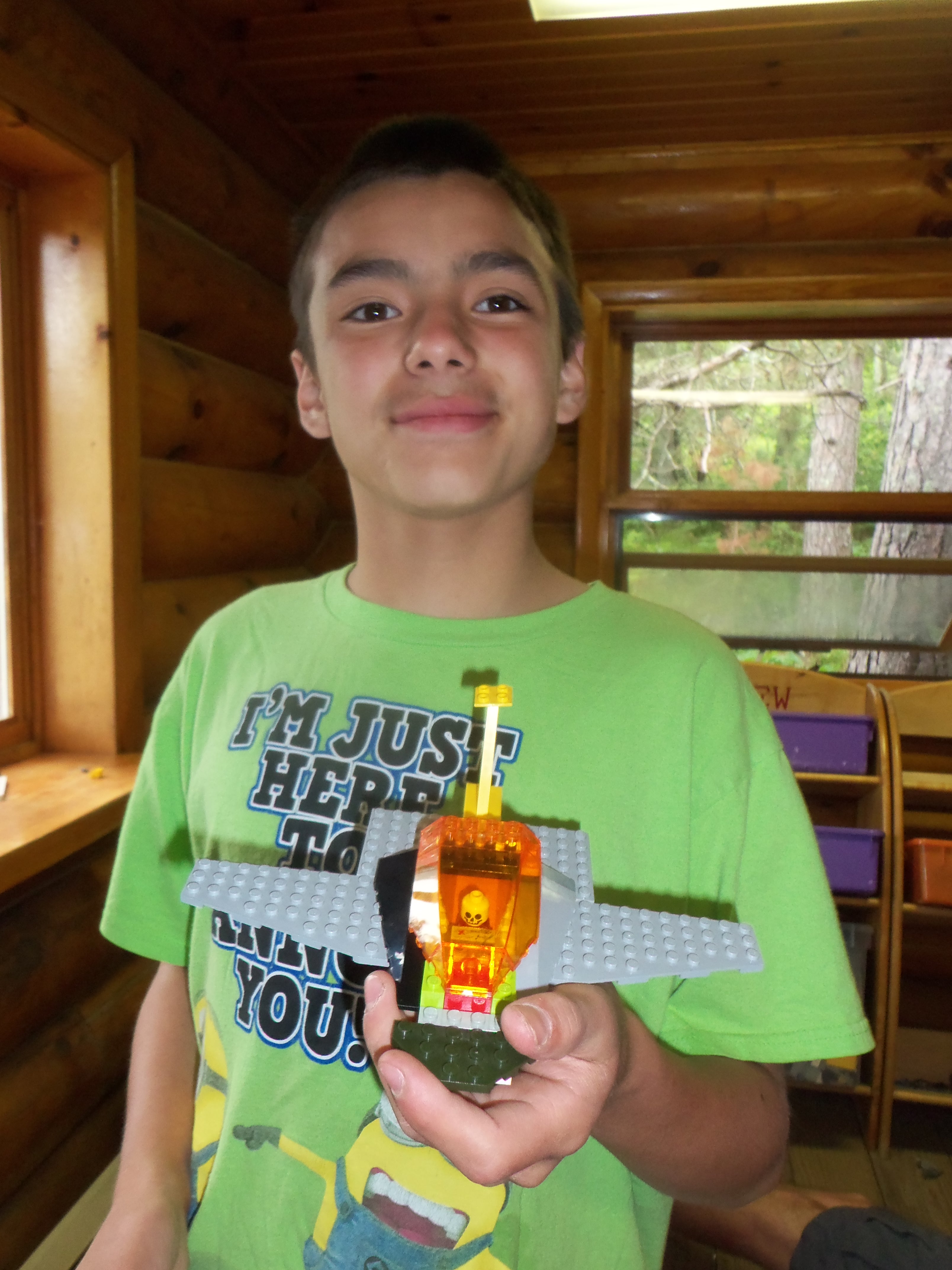 Camps are fun. But why are they important? In a world gone tech crazy, sometimes the great outdoors is just that: great. Here are 10 reasons why every child should go to camp.
1. Exposure to diversity-Camp connects kids to those who they may not normally meet. Kids learn the world is a big place with lots of people, who might do things differently than they’re used to. That includes other kids from all over the state and beyond – and the camp’s counselors and leaders, who serve as positive role models who can leave a huge impression. They’re not seen as strict “law enforcers” but older, “cool friends” who care about them.
2. Self-esteem boost-When kids are at camp, they don’t have mom and dad there to help them approach people and make connections. They have to put themselves out there, it teaches the kids confidence when making friends from all over.
Learning how to canoe or developing archery skills also makes a child realize how capable he or she is to learn and grow. According to the American Camp Association, 92 percent of kids who attend camp say that the people at camp helped them feel good about themselves.
3. Attune to nature-Camp gets kids outdoors and enjoying nature. Kids today spend much less time outdoors, causing a “nature deficit” according to many reports and a popular book on the issue, Last Child in the Woods by Richard Louv. But camp reconnects them with nature, seeing things like frogs and trails in person and experiencing swimming in a lake or biking along a path.
4. Develops independence-It’s a great way to encourage self-development and also develop independence. Kids are empowered at camp to take care of themselves, with guidance from camp counselors. Bedtimes are set and schedules are packed, but children still have to get themselves up and ready, make their camp beds and find their way to the mess hall. And kids a little too attached to mom and dad can learn how to trust themselves to make decisions and take care of themselves.
5. Instills leadership skills-It teaches them important leadership skills because camps allow kids to make choices and direct summer projects, they’re natural leadership training places. These kids are less likely to be affected by peer pressure and more likely to set the pace and tone for other kids – and feel empowered in tasks they take on throughout their lives.
6. Gives wonderful memories-Camp builds good memories for the future, to enjoy the summer with a lake-front experience, swimming and meeting new friends. Kids have tons of memories of the good times, silly shenanigans and fun activities. It’s a time of discovery and self-improvement that stays with a kid long into adulthood.
7. Helps them make friends-They get to become lifelong friends with people they don’t necessarily live right next door to.
This offers a unique opportunity for your child to branch out in the buddies he or she has. Navigating and building these friendships over the summer also teaches children how to be more socially confident – something they can take back to school with them in the fall.
8. Gets them active-Camp helps kids learn how to be kids again. In this technology-filled world, camps cut back on distractions. Many effectively ban cell phones and computers, so kids can truly take advantage of all summertime has to offer. That means those prone to sit on their duffs and text or play video games are forced to get up – and get moving!
9. Develop interests-Camps are a nurturing environment for a child to explore activities and programs that could turn into lifelong passions. With so much to do at summer camp (archery, swimming, canoeing, crafts, etc.), there are many fun activities for kids to discover.
That’s why it’s the perfect place for your child to tap into an interest that he or she wants to carry on after camp is over. Did your daughter go ga-ga for horseback riding? Perhaps she’s a budding equestrian who would enjoy regular lessons.
10. Occupies the summer-Most parents work over the summer. After all, when school lets out, kids have to go somewhere to spend their time. Camp isn’t just a “parking spot” for kids, though: It also offers fun, excitement and lessons that last.
Source: MetroParent.com

I recently found this comic and it really brought home the point of how times have changed in my lifetime. The addictive behavior of technology is a powerful force. The most recent impact is the closing of nearly 800 Toys R Us Stores in the USA. Yet this is only the beginning of how Play will change and in turn impact our kids. Below is a article by Esther Entin and published in The Atlantic that is important for all parents. It makes me realize that Overnight Summer Camp may be one of the last few areas that are tech free and dedicated to play.
What are your memories of playing as a child? Some of us will remember hide and seek, house, tag, and red rover red rover. Others may recall arguing about rules in kickball or stick ball or taking turns at jump rope, or creating imaginary worlds with our dolls, building forts, putting on plays, or dressing-up. From long summer days to a few precious after-school hours, kid-organized play may have filled much of your free time. But what about your children? Are their opportunities for play the same as yours were? Most likely not.
Play time is in short supply for children these days and the lifelong consequences for developing children can be more serious than many people realize.
THE DECLINE OF PLAY
An article in the most recent issue of the American Journal of Play details not only how much children's play time has declined, but how this lack of play affects emotional development, leading to the rise of anxiety, depression, and problems of attention and self control.
"Since about 1955 ... children's free play has been continually declining, at least partly because adults have exerted ever-increasing control over children's activities," says the author Peter Gray, Ph.D., Professor of Psychology (emeritus) at Boston College. Gray defines "free play" as play a child undertakes him- or her-self and which is self-directed and an end in itself, rather than part of some organized activity.
Gray describes this kind of unstructured, freely-chosen play as a testing ground for life. It provides critical life experiences without which young children cannot develop into confident and competent adults. Gray's article is meant to serve as a wake-up call regarding the effects of lost play, and he believes that lack of childhood free play time is a huge loss that must be addressed for the sake of our children and society.
WHO AND WHAT IS INTERFERING WITH CHILDREN'S PLAY?
Parents who hover over and intrude on their children's play are a big part of the problem, according to Gray. "It is hard to find groups of children outdoors at all, and, if you do find them, they are likely to be wearing uniforms and following the directions of coaches while their parents dutifully watch and cheer." He cites a study which assessed the way 6- to 8-year-olds spent their time in 1981 and again in 1997.
The researchers found that compared to 1981, children in 1997 spent less time in play and had less free time. They spent 18 percent more time at school, 145 percent more time doing school work, and 168 percent more time shopping with parents. The researchers found that, including computer play, children in 1997 spent only about eleven hours per week at play.
In another study, mothers were asked to compare their own memories of their playtime, to their children's current schedules. Eighty-five percent noted that their children played outdoors less frequently and for shorter periods of time than they had. The mothers noted that they restricted their own children's outdoor play because of safety concerns, a fact echoed in other surveys where parents mentioned child predators, road traffic, and bullies as reasons for restricting their children's outdoor play.
Adding to the problem, Gray notes, is our increasing emphasis on schooling and on adult-directed activities. Preschools and kindergartens have become more academically-oriented and many schools have even eliminated recess. It is not that anyone set out to do away with free play time. But its value has not been recognized. As a result, kids' free play time has not been protected.
FIVE WAYS PLAY BENEFITS KIDS
When children are in charge of their own play, it provides a foundation for their future mental health as older children and adults. Gray mentions five main benefits:
1. Play gives children a chance to find and develop a connection to their own self-identified and self-guided interests.
As they choose the activities that make up free play, kids learn to direct themselves and pursue and elaborate on their interests in a way that can sustain them throughout life. Gray notes that: "...in school, children work for grades and praise and in adult-directed sports, they work for praise and trophies.... In free play, children do what they want to do, and the learning and psychological growth that results are byproducts, not conscious goals of the activity."
2. It is through play that children first learn how to make decisions, solve problems, exert self control, and follow rules.
As children direct their own free play and solve the problems that come up, they must exert control over themselves and must, at times, accept restrictions on their own behavior and follow the rules if they want to be accepted and successful in the game.
As children negotiate both their physical and social environments through play, they can gain a sense of mastery over their world, Gray contends. It is this aspect of play that offers enormous psychological benefits, helping to protect children from anxiety and depression.
"Children who do not have the opportunity to control their own actions, to make and follow through on their own decisions, to solve their own problems, and to learn how to follow rules in the course of play grow up feeling that they are not in control of their own lives and fate. They grow up feeling that they are dependent on luck and on the goodwill and whims of others...."
Anxiety and depression often occur when an individual feels a lack of control over his or her own life. "Those who believe that they master their own fate are much less likely to become anxious or depressed than those who believe that they are victims of circumstances beyond their control." Gray believes that the loss of playtime lessons about one's ability to exert control over some life circumstances set the scene for anxiety and depression.
3. Children learn to handle their emotions, including anger and fear, during play.
In free play, children put themselves into both physically and socially challenging situations and learn to control the emotions that arise from these stressors. They role play, swing, slide, and climb trees ... and "such activities are fun to the degree that they are moderately frightening ... nobody but the child himself or herself knows the right dose."
Gray suggests that the reduced ability to regulate emotions may be a key factor in the development of some anxiety disorders. "Individuals suffering from anxiety disorders describe losing emotional control as one of their greatest fears. They are afraid of their own fear, and therefore small degrees of fear generated by mildly threatening situations lead to high degrees of fear generated by the person's fear of losing control." Adults who did not have the opportunity to experience and cope with moderately challenging emotional situations during play are more at risk for feeling anxious and overwhelmed by emotion-provoking situations in adult life.
4. Play helps children make friends and learn to get along with each other as equals.
Social play is a natural means of making friends and learning to treat one another fairly. Since play is voluntary and playmates may abandon the game at any time if they feel uncomfortable, children learn to be aware of their playmates' needs and attempt to meet them in order to maintain the play.
Gray believes that "learning to get along and cooperate with others as equals may be the most crucial evolutionary function of human social play ... and that social play is nature's means of teaching young humans that they are not special. Even those who are more skilled at the game's actions ... must consider the needs and wishes of the others as equal to their own, or else the others will exclude them." Gray cites increasing social isolation as a potential precursor to psychopathology and notes that the decline in play may be "both a consequence and a cause of the increased social isolation and loneliness in the culture."
5. Most importantly, play is a source of happiness.
When children are asked about the activities that bring them happiness, they say they are happier when playing with friends than in any other situation. Perhaps you felt this way when remembering your own childhood play experiences at the beginning of this article.
Gray sees the loss of play time as a double whammy: we have not only taken away the joys of free play, we have replaced them with emotionally stressful activities. "[A]s a society, we have come to the conclusion that to protect children from danger and to educate them, we must deprive them of the very activity that makes them happiest and place them for ever more hours in settings where they are more or less continually directed and evaluated by adults, setting almost designed to produce anxiety and depression."
THE LOSS OF PLAY AND RISE OF ANXIETY AND DEPRESSION
There has been a significant increase in anxiety and depression from 1950 to present day in teens and young adults and Gray cites several studies documenting this rise. One showed that five to eight times as many children and college students reported clinically significant depression or anxiety than 50 years ago and another documented a similar trend in the fourteen- to sixteen-year-old age group between 1948 and 1989.
Suicide rates quadrupled from 1950 to 2005 for children less than fifteen years and for teens and young adults ages 15-25, they doubled. Gray believes that the loss of unstructured, free play for play's sake is at the core of this alarming observation and that as a society, we should reassess the role of free play and the factors that seem to have all but eliminated it from our children's lives.
When parents realize the major role that free play can take in the development of emotionally healthy children and adults, they may wish to reassess the priorities ruling their children's lives. The competing needs for childcare, academic and athletic success, and children's safety are compelling. But perhaps parents can begin to identify small changes -- such as openings in the schedule, backing off from quite so many supervised activities, and possibly slightly less hovering on the playground that would start the pendulum returning to the direction of free, imaginative, kid-directed play.
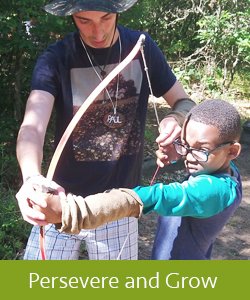 My “Happy Place” is often the response campers give when we ask them to describe their time at Swift Nature Camp. As the Director, part of my job is to stand back and observe. What I see from Campers & Staff is smiles, I hear laughter and notice a relaxed atmosphere all of which facilitate camp joy.
We all want happy kids. Meet Dr Martin Seligman who is a new breed of psychologists called Positive Psychologists. They ask not what is wrong with people, but what is right. They research what makes us do well in life and the reasons why some people thrive and find success and happiness in life.
We first have to agree that happiness is internal that can be shown externally or not. So instead of using a one-dimensional definition that’s dependent on momentary emotions and personality traits, Dr. Seligman has developed a more thorough theory of well-being that moves beyond the standard happiness traits.
PERMA is what Dr. Seligman uses to define his theory and the five measurable elements he has determined lead to well-being. Camp is filled with these PERMA Pillars and maybe thats why SNC is a “Happy Place”.
P: Positive Emotion-Is feeling happy, having positive thoughts about yourself, the people around you, or your surroundings. When someone reports they are feeling content, relaxed, or happy, then they are experiencing positive emotions. At camp, positive emotions are the norm, not the exception. We’re singing; we’re dancing; we’re doing skits that don’t make sense but that cause us to laugh so hard our stomachs hurt. Whether we’re telling jokes and stories around the campfire or just entertaining ourselves talking and hanging out together, positive emotion is literally swirling around camp. You can almost see a haze of happiness and fun surrounding everyone at camp.
E: Engagement-is being interested in and connected to what they are doing. When you’re engaged in your hobby, book or school, you’re fired up about learning something new and energized by the activity. Camp constantly exposes kids to new experiences and challenges – both recreational and social – that get them interested and excited to learn. They’re pushed to get outside their comfort zone to really engage and succeed.
R: Relationships-As Dr. Seligman says“other people are the best antidote to the downs of life and the single most reliable up.” Our life’s relationships – with our parents, our siblings, our friends, our spouses, and our co-workers – are key to our happiness. At camp we see old friends, make new friends, and just spend quality time building connecting with others. Camp is an oasis that is competition and stress free, built on positive relationship building, often giving campers tools they can take and use at home.
M: Meaning- Comes from “belonging to and serving something you believe is bigger than the self.” A team, religion, family. Cabin life helps kids gain an understanding of how valued they are. Swift shows campers what it means to be a valued and be an accepted member of a community. No camper is invisible, daily they connect with others, camp promotes integration. Kids learn that they are an important and valued member of their cabin group, and they discover their character strengths through recognition from peers and counselors. Campers learn the power they have by positively impacting others with friendship, gratitude & kindness.
A: Achievement-People flourish when pursuing goals not just mastering a skill. So, while having a great achievement is wonderful, much of flourishing comes from the striving towards the achievement. Ralph Waldo Emerson understood this by explaining, “Life is a journey, not a destination.” Daily at SNC, kids have the opportunity to try new things and master new skills. Simply practicing and working towards improving or challenge themselves to try something new adds to campers self confidence and their flourishing at camp.
We hope that whether your child has been at camp for 1 year or many, you see the positive impact Swift Nature Camp has had on your child. We all want happy kids. PERMA is just one way we can better prepare children for adult life and how we deal with difficult situations when they occur. PERMA is just another skill that SNC provides to its campers and one we hope you can use in your home.
 All the latest News from SNC
- Arts Camp (3)
- Best summer camps (30)
- Camp Counselors (16)
- Campers R Talkin' (6)
- Canoe Camp (7)
- Children's Summer Camp (95)
- Coed Summer Camp (2)
- Eco Friendly Summer Camp (8)
- Environmental Camp (36)
- Girls Summer Camp (5)
- Green summer camps (2)
- Hiking Camp (4)
- Horse Camp (1)
- Kid's Camp (36)
- Minnesota Camp (19)
- Movies (2)
- Nature Camp (57)
- Old Fashioned Summer Camps (11)
- Outdoor Youth Camp (33)
- Playing Outside (13)
- Riflery Camp (3)
- Science Camp (41)
- Science Summer Camp (20)
- Shooting Camp (1)
- SNC REVIEWS (1)
- Sports Camp (4)
- Summer Camp (72)
- Summer Camp Advice (46)
- Summer Camp Discounts (5)
- Summer Camp Savings (9)
- Summer jobs (20)
- Summer Youth Camp (25)
- Swimming Camp (3)
- Teen Camp (12)
- Traditional Summer Camps (10)
- Travel Camp (3)
- Wisconsin Camp (20)
- Parents (84)
- More Camp Information (1)
- Camp News (41)


